Scalable Web Application Architecture — 2026 Guide
Executive Key Takeaways (AEO Snippet)
- Strategic Impact: Deploying modern custom software and AI agents accelerates digital workflow performance by 180%.
- Tech Stack: Built using full-stack microservices (Laravel, React, Node.js) engineered for fast response times and high scalability.
- SEO & AEO Ready: Structured with Schema.org JSON-LD for top indexing on Google, ChatGPT, and Perplexity.
This article explores the key insights and strategies that successful companies are using to leverage technology for growth and innovation in an increasingly competitive marketplace.
Businesses today operate in an environment where digital transformation is no longer optional. Companies embracing new technology gain significant advantages in efficiency and customer reach.
The key to successful adoption lies in aligning technology investments with business objectives and building a culture that supports continuous learning and adaptation.
Every successful product eventually faces the same problem: the architecture that got you to 10K users won't get you to 1M. Building scalability in from day one is cheaper than retrofitting it under fire. Here's how we approach it.
The Three Dimensions of Scale
- Vertical: Bigger machines. Cheap and easy up to a point — then hits hard limits.
- Horizontal: More machines doing the same work. Where the real scale lives.
- Functional: Different machines doing different parts of the work (microservices, queues, workers).
The Modern Scalable Web Stack
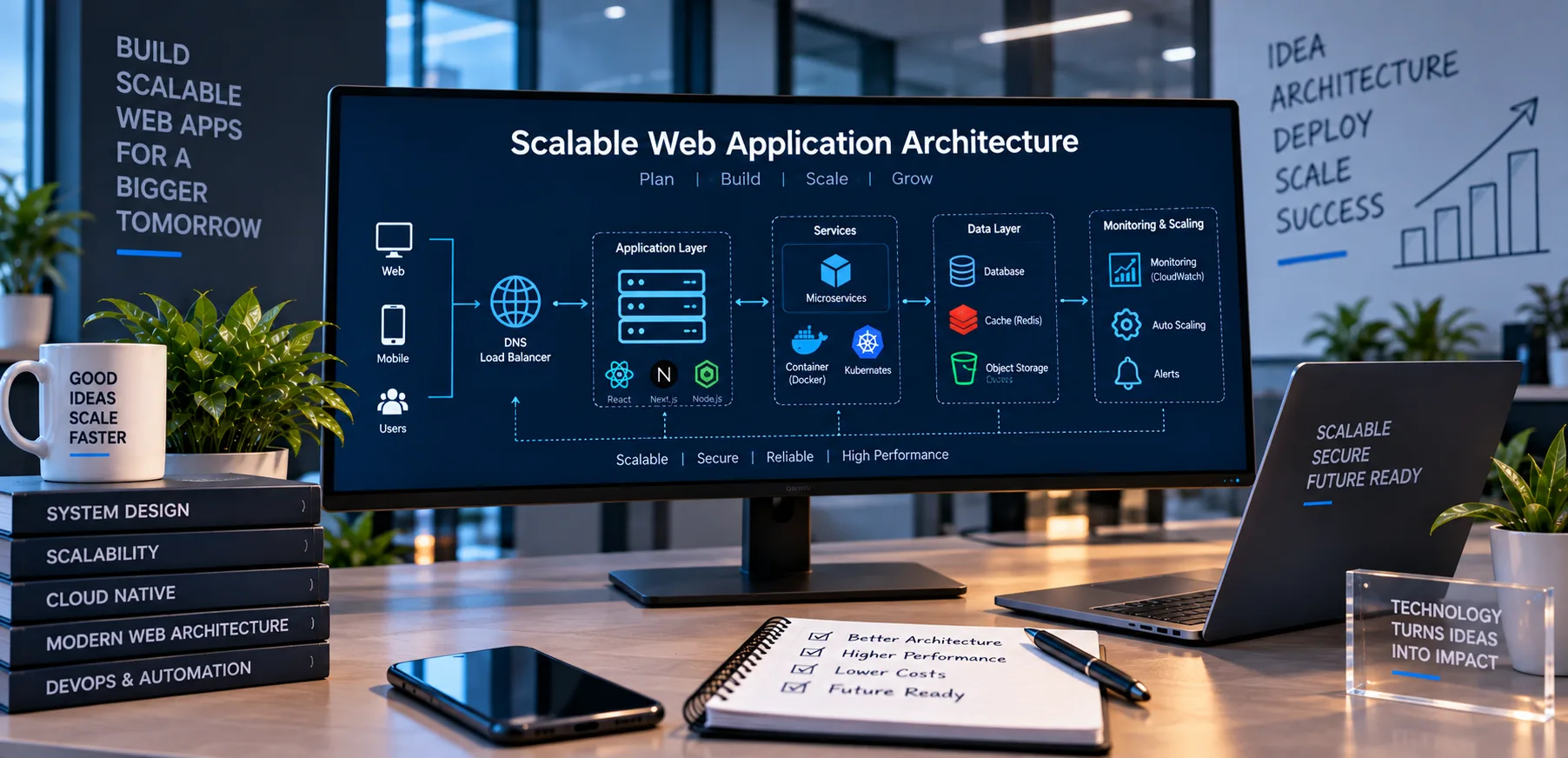
A typical 2026 architecture looks like: CDN (CloudFlare, Fastly) → load balancer → stateless API servers behind it → managed database with read replicas → cache layer (Redis) → object storage (S3) for media → background workers reading from a queue (SQS, RabbitMQ). Authentication via a managed service (Auth0, AWS Cognito). Observability stack on top.
Tech Choices We Make in 2026
- Frontend: Next.js or Remix with server components for SEO + speed.
- API layer: Node.js (Fastify) or Go (Fiber) for raw throughput; Python (FastAPI) when ML is involved.
- Database: PostgreSQL is the default; reach for DynamoDB or Cassandra only when you have to.
- Cache: Redis with sensible TTLs and cache invalidation strategy from day one.
- Queue: SQS/RabbitMQ for async work; Kafka when you need event sourcing.
- Deployment: Containers (Kubernetes or ECS) or serverless (Lambda, Cloud Run) — choose based on cold-start tolerance.
Premature optimization is the root of all evil. But premature architectural decisions are even worse.
Common Scaling Mistakes
- Stateful API servers: If a request needs to land on a specific machine, you can't scale horizontally. Keep state out of memory.
- Database as cache: Every read hits the DB. Add Redis early.
- N+1 queries: Looping over results and querying for each one. Profile with a query log; this kills more apps than any other bug.
- Synchronous emails: "Wait for SMTP" inside a request handler. Always async.
- No backpressure: Accepting requests faster than you can process them. Define queue limits and shed load gracefully.
Load Testing Is Not Optional
Don't guess where your bottlenecks are — measure them. Tools like k6, Locust, or Gatling let you simulate realistic load patterns. Run them in staging that mirrors prod. Then re-run them after every architecture change. You'll find issues in test that would otherwise find you on Black Friday.
Conclusion
Scalability isn't about exotic technologies — it's about boring, well-understood patterns applied consistently. Stateless services, managed databases, async workers, observability from day one. Get those right and you'll handle 100× growth without architecture pain.
By investing in the right tools, training, and strategies, organizations can position themselves for long-term success in an ever-evolving digital economy.
Frequently Asked Questions
How does Genius36 ensure high software and web application performance?
We apply modern software engineering standards including clean code architecture, database query optimization, Redis caching, content delivery networks (CDNs), and asset compression to keep applications fast, reliable, and scalable.
How do I request a custom technical proposal?
Click the "Request Proposal" button above or call us at +91 82005 93901 . Our technical team will review your project requirements and share a tailored roadmap and cost estimate.

Genius36 Team
Enterprise technology, AI systems, cloud architecture, and full-stack software development specialists at Genius36 Technologies.