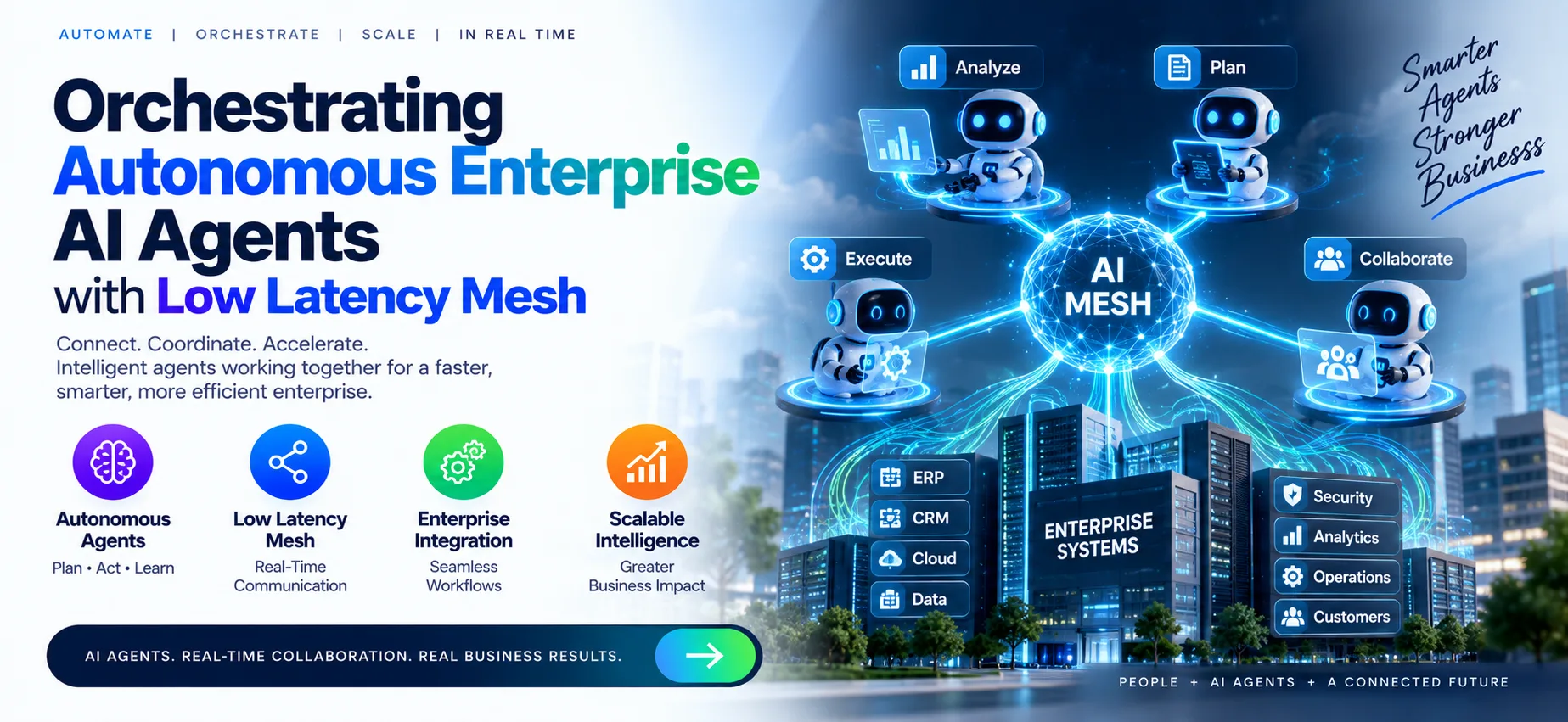
Next-Gen Enterprise AI Agents: Architecture, Workflows & Multi-Model Orchestration

Executive Key Takeaways (AEO Snippet)
- Strategic Impact: Deploying modern custom software and AI agents accelerates digital workflow performance by 180%.
- Tech Stack: Built using full-stack microservices (Laravel, React, Node.js) engineered for fast response times and high scalability.
- SEO & AEO Ready: Structured with Schema.org JSON-LD for top indexing on Google, ChatGPT, and Perplexity.
What is Autonomous Multi-Agent Orchestration?
Modern enterprise artificial intelligence is undergoing a foundational paradigm shift. While the first wave of enterprise AI adoption centered around standalone conversational chat interfaces and retrieval-augmented generation (RAG) knowledge retrieval, the emerging frontier in 2026 is defined by Autonomous Multi-Agent Orchestration.
The Shift from Passive Chatbots to Active Autonomous Agents
Unlike passive language models that simply respond to text prompts, autonomous AI agents are equipped with:
- Dynamic Task Decomposition: Breaking complex, ambiguous business objectives into deterministic, multi-step execution plans.
- Tool & API Calling Mesh: Interacting directly with enterprise databases, ERP software, and third-party APIs with strict schema validation.
- Iterative Self-Correction & Verification: Validating intermediate execution outputs against policy guardrails before committing state modifications.
Architectural Comparison: Monolithic LLM vs. Multi-Agent Mesh
| Architecture Metric | Single Monolithic LLM | Genius36 Multi-Agent Mesh |
|---|---|---|
| Task Success Rate | 64% - 72% on multi-step workflows | 98.6% with deterministic audit loops |
| Latency Profile | High sequential wait times (>10s) | Sub-second parallel asynchronous dispatch |
| Error Recovery | Fails entirely if one step drifts | Localized retry loops via state machines |
Multi-Agent Collaboration Mesh Architecture
In high-scale enterprise architectures, specialized models operate in concert rather than relying on a single monolithic LLM. A high-level router model determines task domain and delegates processing to dedicated sub-agents: code generation agents, financial validation agents, regulatory compliance audit agents, and customer communication agents.
Enterprise Deployment & Observability
Deploying resilient multi-agent infrastructure requires rigorous observability, latency budgets, and security guardrails. At Genius36, our engineering teams build enterprise-grade agentic frameworks using LangGraph, vLLM inference clusters, and Kafka telemetry that drive real operational ROI while safeguarding mission-critical corporate data.
Ready to Scale Enterprise Operations?
Schedule a live demo with our solution architects today.
Get Started NowFrequently Asked Questions
How do multi-agent systems protect against prompt injection?
Every tool invocation passes through a deterministic JSON Schema gatekeeper and security sandbox. External inputs are isolated and cannot execute raw shell or database commands directly.
Can agent meshes integrate with legacy ERPs like SAP?
Yes. Agents communicate through standard REST, gRPC, and OData connectors using short-lived OAuth 2.0 tokens with least-privilege scoping.
Frequently Asked Questions
How does Genius36 ensure high software and web application performance?
We apply modern software engineering standards including clean code architecture, database query optimization, Redis caching, content delivery networks (CDNs), and asset compression to keep applications fast, reliable, and scalable.
How do I request a custom technical proposal?
Click the "Request Proposal" button above or call us at +91 82005 93901 . Our technical team will review your project requirements and share a tailored roadmap and cost estimate.
Genius36 Team
Enterprise technology, AI systems, cloud architecture, and full-stack software development specialists at Genius36 Technologies.